
Introduction to the World of Automation
In a digital era driven by innovation, businesses constantly seek ways to enhance efficiency, reduce costs, and elevate customer experience. AI Automation and RPA (Robotic Process Automation) have emerged as critical tools to help organizations achieve these goals. However, many remain confused about how these two technologies differ and which one is best suited for their specific needs. This article will delve into the key distinctions between AI Automation and RPA, providing a thorough understanding to help you apply them effectively in your business.
What is RPA (Robotic Process Automation)
RPA, or Robotic Process Automation, is a technology that utilizes software robots (or bots) to emulate human actions in performing repetitive, rule-based, and structured business activities. RPA bots are not physical robots; they are computer programs that operate on your computer, much like a human uses a mouse and keyboard.
How RPA Works
RPA functions by recording and replaying the steps a human takes through a user interface. This includes mouse clicks, data entry, copying and pasting information, and interacting with various applications, all without complex coding. RPA strictly follows a predefined set of instructions or rules, ensuring accuracy and consistency in its operations.
RPA Use Cases
- Data Entry Transferring data from one system to another, such as entering new customer information into a CRM.
- Report Generation Collecting data from multiple sources and compiling reports in a specified format.
- Invoice Processing Receiving, validating, and approving invoices according to predefined conditions.
- Customer Request Handling Responding to repetitive emails or messages.
- Data Verification Comparing data from two systems to identify inconsistencies.
Advantages and Limitations of RPA
The advantages of RPA include its ability to perform repetitive tasks quickly, accurately, 24/7, reducing human errors, and allowing employees to focus on more creative and complex decision-making tasks. Additionally, implementing RPA typically involves relatively low initial time and cost.
The limitations of RPA are its inability to perform tasks requiring decision-making, analysis, or learning from unstructured data. If the operating environment or rules change, RPA needs to be reprogrammed.
What is AI Automation
AI Automation, or Artificial Intelligence-driven Automation, integrates Artificial Intelligence (AI) technologies into automated processes. This enables systems to perform more complex tasks, possess the ability to think, analyze, learn, and make decisions autonomously, distinguishing it from RPA, which operates based on fixed rules.
How AI Automation Works
AI Automation leverages various fields of AI, such as Machine Learning (ML), Natural Language Processing (NLP), Computer Vision, and Deep Learning, to enable systems to:
- Learn from data Improve performance as new data is acquired.
- Understand natural language Analyze and interpret text, speech, or commands from humans.
- Recognize patterns and objects Process images or videos to identify critical information.
- Make intelligent decisions Based on data, analysis, and predictions.
AI Automation Use Cases
- Customer Sentiment Analysis Processing reviews, texts, or social media to understand customer feelings.
- Unstructured Document Management Reading, understanding, and extracting key information from various documents like contracts, legal papers, or applications.
- Intelligent Chatbots Capable of answering complex questions, understanding customer intent, and resolving issues independently.
- Trend Prediction Analyzing historical data to forecast sales, market demand, or risks.
- Quality Inspection Using Computer Vision to inspect products on a production line.
Advantages and Limitations of AI Automation
The advantages of AI Automation include its capability to handle complex and unstructured tasks, high flexibility, ability to learn, adapt, and make decisions independently, helping businesses innovate and enhance their competitive edge.
The limitations of AI Automation are that it is often more complex to implement and use, requires vast amounts of data for training AI models, and has higher initial costs, along with the need for specialized experts.
AI Automation vs RPA The Key Differences
While both AI Automation and RPA share the common goal of automating business processes, there are fundamental differences that make each technology suitable for distinct tasks.
Learning and Adaptation Capabilities
- RPA lacks the ability to learn or adapt. It strictly follows predefined rules. If situations deviate from expectations, it cannot handle them.
- AI Automation can learn from data, improve performance, and adapt to new situations, making it better at handling uncertainty and complexity.
Decision Making
- RPA‘s decisions are based on clearly pre-defined rules (Rule-based). Without supporting rules, it cannot make decisions.
- AI Automation can make intelligent decisions based on data analysis, learned patterns, and predictions, allowing it to handle unforeseen situations.
Suitable Task Types
- RPA is ideal for repetitive, high-volume, rule-based tasks with structured data, such as data entry and report generation.
- AI Automation is suitable for complex tasks requiring analysis, interpretation, and handling of unstructured data, such as document analysis and answering diverse customer queries.
Data Handling
- RPA works well with structured data in a clear format.
- AI Automation can process and understand various data formats, both structured and unstructured, including text, voice, and images.
Flexibility and Complexity
- RPA has low flexibility. If processes change, the program needs to be reconfigured. It typically has less complexity in installation and use.
- AI Automation offers high flexibility, adapting better to new situations. However, it involves higher complexity in installation, development, and maintenance, and requires specialized experts.
Cost and Investment
- RPA generally has lower initial costs and a faster Return on Investment (ROI) for suitable tasks.
- AI Automation often has higher initial costs, including investment in data, model training, and infrastructure, but provides long-term returns that can transform a business.
When to Use AI Automation and When to Use RPA
Choosing the appropriate technology depends on your specific task characteristics and business goals.
Consider RPA when
- The task is repetitive and high-volume.
- There are clear, unchanging rules.
- The data used is structured data.
- You need rapid implementation and quick results.
- You want to reduce human errors in routine tasks.
Consider AI Automation when
- The task requires complex decision-making.
- You need to handle unstructured data, such as text, voice, or images.
- You want the system to learn and adapt autonomously.
- You aim to innovate or enhance competitive capabilities.
- You need to analyze deep insights for forecasting and planning.
In many cases, businesses can gain the most benefit from integrating both AI Automation and RPA, known as Hyperautomation. RPA handles repetitive, structured tasks, while AI enhances the ability to analyze, learn, and make decisions, leading to fully automated and intelligent workflows.
Benefits of Implementation in Business
Implementing AI Automation and RPA in business, whether separately or integrated, brings immense benefits.
- Increased Operational Efficiency Reduces time spent on repetitive tasks, allowing employees to focus on higher-value work.
- Cost Reduction Decreases the need for human labor for routine tasks and minimizes costly errors.
- Enhanced Accuracy Automated systems perform tasks more accurately than humans, reducing error rates.
- Improved Customer Experience Faster and more accurate responses through chatbots or other automated systems.
- Better Insights and Decision Making AI helps analyze vast amounts of data to find trends and insights.
- Scalability Automated systems can easily scale operations according to business needs.
The Future of AI Automation and RPA
The future of AI Automation and RPA will see increasingly closer collaboration to create intelligent and adaptive automation systems. AI technology will augment RPA’s capabilities in handling complex and unstructured tasks, leading to comprehensive and highly efficient Hyperautomation processes. Businesses that understand and can appropriately apply both technologies will gain a competitive advantage in a rapidly evolving business world.
Conclusion
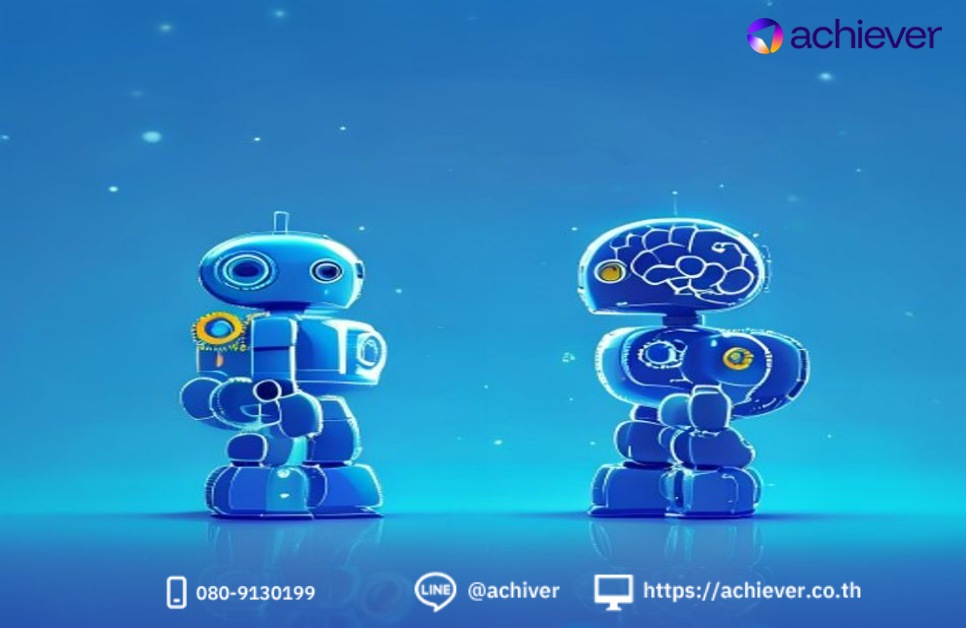
Understanding the distinctions between AI Automation and RPA is crucial for organizations looking to intelligently deploy automation technologies. RPA acts like the limbs, following clear instructions, suitable for structured and repetitive tasks. In contrast, AI Automation functions like the brain, capable of thinking, analyzing, learning, and making decisions, ideal for complex tasks requiring flexibility. Choosing the right technology, or integrating both, will enable your business to increase efficiency, reduce costs, and innovate for long-term success.
Have a website or system idea you want to develop?
Let’s talk and turn your idea into real sales Tel: 080-9130199
 LINE: @achiver
 https://lin.ee/E6eAE0F